What are Tariffs, and How Do They Work?

The salt tax originated in China around 300 BC. It became so successful and profitable that it was used to help finance the construction of the Great Wall. Source
Many readers will be too young to know how things were before the introduction of “free trade” and all the various trade agreements signed between so many nations. In those days we had “customs duties”, which were simply a tax on imports. At one time, almost everything brought in from another country was subject to these import taxes, which were often prohibitively high.

Valentino Valentino extrait (pure perfum) 1000 ml. Rare, vintage original 1978.US$ 16,000.00 + tax
Approximately EUR 13,599.66 + tax.
And if not high, at least prohibitively complicated. Every kind of product, in almost every economic sector, was subject to these import duties, and within each sector the duties were numerous and confusing. As an example with simple toys, there were duties of various percentages according to the material from which the toy was made. Wooden toys had different tax percentages than did metal toys or fabric toys. Wind-up toys had different tax percentages than battery-operated toys. And so on. Clothing was the same. Every kind of fabric or leather had its own percentage of import tax, and the total number of classifications of these clothing taxes was in the hundreds. If this weren’t bad enough, the duties depended not only on the value of the product, but often on the country of origin. To a normal human, these myriad categories defied understanding and seemed so mysterious as to be occult. Few importers had the expertise to navigate the customs maze, most having to hire a customs broker to clear shipments.
These duties – taxes on imports – applied as much to individuals as to enterprise importers. If you were on a holiday in France and purchased a bottle of perfume in a shop in Paris, you would have to declare that purchase when entering the US or Canada, and pay the tax. As an example, perfume had an import duty (if I remember correctly) of 50%. So, if the perfume cost $100, when you proceeded through customs, you would have to pay a tax of $50. If you didn’t want to pay, the customs official would seize the item and it would be destroyed. The process was essentially the same if you had the perfume shipped or mailed to you from Paris, instead of bringing it with you on the airplane. You would be notified when the package arrived at customs, and you would have to go to the customs office, pay the import tax – the duty – to take possession of your perfume. If you didn’t appear at the office or didn’t want to pay the duty, the item would again be seized and destroyed.
One point to note is that the duties on most products were sufficiently high that the average person would seldom encounter foreign goods. As a child growing up in Canada, any product from another country was an object of reverence to us, simply due to the rarity.A bicycle made in the US or Europe would attract not only much attention, but an excess of envy. To children, it would have been the same if those products had come from Mars or Venusinstead of New York or Hamburg.

A classic Sony Walkman portable cassette player is displayed at the ‘I Grew Up 80s’ exhibition at Dorset Museum, on December 01, 2022 in Dorchester, Dorset. Source
The free-trade agreements eliminated virtually all of this bewildering maze, and countries suddenly became international. Goods from every country were soon flooding the stores, until “foreign” was no longer a novelty. By the time I was in my late teens or early 20s, everyone was enjoying foreign products. Japanese electronic items were the most notable of these. Does anyone remember the marvel of Japanese transistor radios? The Sony Walkman?
Duty-Free Shops

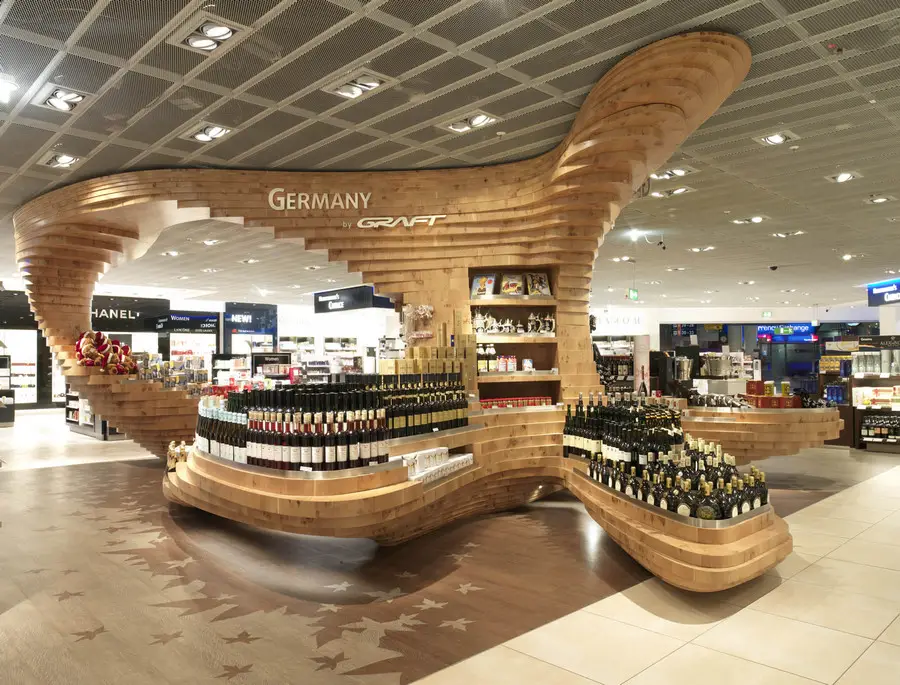
Heinemann Duty Free Shop Frankfurt Airport. Source
Increasingly from the 1960s and 1970s, most goods from most countries could be imported duty-free. Do you know this term – “duty-free”? We still have duty-free shops at most airports, although today they are mostly scam operations. I know the owners won’t like this adjective, but it’s essentially correct. The truth is that with the advent of free trade, the duty-free shops lost their only reason for existence.
In the past, these shops were a blessing because they had the right to sell many kinds of so-called luxury goods or restricted items at the normal retail price, permitting purchasers to avoid the high duties. They typically sold cigarettes, cigars, liquors and alcoholic beverages of all kinds, chocolate, some jewelry, various food items, and many perfumes and cosmetics. But when the free-trade agreements emerged, the duties on most items disappeared, so the duty-free shops had no advantage over any other retail store. And that is still the case today. Their prices are seldom lower than other retail stores, and are often higher. I sometimes browse through the offerings at these shops when I travel, to compare the prices. I almost always find that I can purchase the identical products at a lower price at any shopping mall in Shanghai, compared to the prices in the so-called “duty-free” shops. They attract customers primarily by trading on the fiction of something that hasn’t existed for 50 years or more.
What are Tariffs?

Now, let’s look at tariffs. What is the difference between an import duty (or an import tax) and a tariff? Nothing. There is no difference. Tariff and duty are two words describing the same thing. There are many authors on many websites who will try to make arcane distinctions between a tax, a duty, and a tariff. Don’t listen to them. These three cats are not only the same breed; they are the same size and color.
Today, we have eliminated “customs duties” and created a new population punishment called “tariffs”, but this is not different than changing your dog’s name from Spot to Rover. It’s still exactly the same animal. The important point to understand is that what today we call tariffs are a welfare program for companies that cannot compete on their own. A tariff is merely a tax on imports, exactly as was a duty. Its effect is to drive up the cost of foreign-produced goods, thus protecting domestic manufacturers who cannot produce quality goods at a reasonable, competitive price. But, for the purposes of this article, the salient point is that a tariff is a duty is a tax.
However, there is a distinction worthy of note. After the introduction of free-trade agreements all over the world, some governments discovered that not everyone was created equal. As one example, the US government discovered that pistachios from Iran (who produce about 75% of the world’s pistachios) were far superior to those grown in California and, without the import taxes (duties), were much less expensive. The obvious result was the imminent bankruptcy of the entire California pistachio industry. You can already see where this is going.
The US government immediately imposed a tax (duty, tariff) on Iranian pistachios that varied between 240% and 350%. The obvious result of course was that pistachios from Iran became prohibitively expensive and Americans had to settle for their own substandard product. But no matter, because the purpose of the Iran pistachio import tax was not to benefit the average American, but to save the California pistachio industry from extinction. And saved, they were, because with the superior Iranian pistachios now priced out of reach, the American growers could raise their prices substantially. And they did. And Americans were suddenly paying twice as much for the same low-grade and poor-quality domestic pistachios, and with no choice options.
This is the reason the US imposed a tariff of 100% on Chinese EVs. The American auto manufacturers cannot make a decent EV at an affordable price, and not at a quality that compares to the Chinese vehicles. If the US were to permit unlimited imports of Chinese EVs, Ford and GM would be reserving plots in the cemetery.
Who Pays the Tariff?

Humpty Dumpty slips from the wall; Humpty’s due for an awful fall / K. Udo J. Keepler’s 1913 political cartoon depicts the impending end of tariffs used to protect U.S. domestic monopolies. (Composite: Letty Avila. Image source: Library of Congress.) Source
There is something fundamental here to understand. It is YOU who pays the import duty or import tax, or tariff, on that perfume you bought in Paris. The factory in France that made the perfume has no responsibility to pay American taxes, and the shop in Paris that sold you the perfume was done with you when you walked out the door. In any case, the US government has no jurisdiction or authority to impose taxes on companies in a foreign country. It is the importer in the US who pays the import taxes. Or duties, or tariffs, or whatever you care to call them. If you are an individual bringing in one bottle of perfume, or an enterprise importing thousands of bottles, it is the same. All import taxes are paid by the person or entity who physically brings the imported goods into the US.You need only think. It cannot be any other way.
To process this further, let’s think of you coming to China to buy a BYD or Xiaomi EV. The cost is US$20,000, and you bring the car back with you on the plane. When you and your EV reach US customs, you will have to pay a 100% tax (or duty or tariff) on that car. The car will now have cost you $40,000. If you have the car shipped to you, the process is the same; when the car reaches US customs, you will be asked to come to the office, pay the $20,000 tax, and take possession of your car.
Now consider if you are a large corporation that imports and sells automobiles. Their position is the same as yours. For every similar Chinese auto they bring into the US, they will have to pay the same $20,000 tax. The car will cost them $40,000. The US mass media published literally hundreds of articles telling Americans that importers would not pass on the cost of the tariffs to their customers, but would “swallow” the tariff. And therefore, there would be no price inflation. And that claim is pure unadulterated rubbish, 100%. Again, you need only think. The importer paid $20,000 for the car and another $20,000 in tax. The car cost him $40,000. If he wants to “swallow” part or all of the tariff (tax, duty, Spot or Rover), he will have to sell the car at below his cost. And that’s how you go bankrupt.
The first rule is that the importer, individual or corporate enterprise, that brings a foreign product into a country, pays the tax (or duty or tariff) when it reaches US customs. There are no exceptions to this rule.
The second rule is that if the importer plans to sell the imported product, they must add the tax onto the purchase price. If they don’t do that, they will be selling a product below their actual cost, and will go out of business.
There is one exception to the second rule. There are a few kinds of products where the profit margins are so high that the import tax (duty, tariff), regardless of the amount, is inconsequential to the importer. I am thinking here of items like ladies’ hair accessories that cost perhaps $0.35 at the factory in China but retail for $4 or $5 in the US. In these cases, even a 100% import tax is so relatively small that the importer can afford to absorb it. But all of these items are trivial consumer goods, small inexpensive items that sell at for a few dollars. There are almost no exceptions to this. Most consumer goods like home appliances, small kitchen appliances, electronics, furniture, food products, have quite low wholesale and retail mark-ups. There simply isn’t enough of a profit margin to permit a retailer to absorb increased import taxes.
The only other category that comes immediately to mind is some of the so-called “luxury” products. I am thinking of an LV handbag that costs the company perhaps $800 at the factory in China, but retails for $10,000 or even $20,000. Here again, the profit margin is so high that even a 100% import tax could be absorbed (“swallowed”) by the importer. Although, in practice, this almost never happens because the customers of these luxury items are not at all price-sensitive. They have enough money that they really don’t care.
I am dwelling on this because Donald Trump, abetted by the tragically-dishonest Western media, repeatedly made the claim that (with products from China for example) it will be “China” who will pay the tariffs. This falsely suggested that the US government would be levying the import tax (the tariff) against the Chinese companies. But think about this: If an American company imports a BYD or Xiaomi EV that costs $20,000, Trump is saying that the Chinese factory would have to pay the 100% tariff of $20,000 when the car reached US customs. This would mean that BYD sells a car to you for $20,000, then pays a $20,000 tax to the US government. And that would mean BYD is selling the car for nothing. And of course, that claim is pathological rubbish.
Moreover, the US government has no jurisdiction or authority to charge any kind of taxes to a foreign company. In real life, it is the importer in the US who pays the import tax (or duty or tariff). To recap, the importer will pay BYD $20,000 for the car, and another $20,000 to the US government in tax. The car now cost the importer $40,000, and he will sell the car to you for the $40,000 cost plus his overhead and profit. It doesn’t matter if we are talking about automobiles, food, toys, clothing, furniture, electronics or any other category. The math is the same. The importer must add the tax to his cost, and that means it is always the consumer – the end user, the last person in the chain, YOU – who ends up paying the cost of the tariffs. It should be obvious this cannot be any other way.
Think of Chinese EVs that cannot enter the US market because of Trump’s tariffs: Without the import taxes, every American would be able to purchase a nice, high-quality EV for between $10,000 and $20,000. But with the tariffs, the cost is twice as much. It is true that the Chinese automaker will have lower sales without the US market, but it is the 300 million Americans who suffer the most, because they will now have to pay hugely increased prices for an American EV of lower quality, and will have almost no choices.
What this means to Americans is that Donald Trump and the mass media have been steadfastly lying to the people about the tariffs. When Donald Trump boasts that “HE” has been receiving “hundreds of billions of dollars” from the tariffs, that part is true. The part that is false is that he didn’t receive that money from “China”. It came out of the bank accounts of every American. And that is one reason prices are rising so steeply in the US. The tariffs are not a tax on foreign companies; they are a tax on American consumers because the tariffs are simply added to the final cost of the goods.
I will provide here another example that may more easily resonate with average consumers. Some years back, when the free trade agreements were made, the blue jean industry in the US was suffering enormously. I’m simplifying things here, but the US blue jean manufacturers would make blue jeans for $20 and sell them for $40. But then importers could begin buying the same quality of blue jeans in China for only $10 and could sell them for $20, below the cost of manufacturing in the US. So, the US government imposed an import tax (duty, tariff) on blue jeans from China at a level that made them more expensive than the local product.
Now think carefully about this. The entire American population could have been buying high-quality blue jeans for only $20 but, because of the import tax, they had to pay at least $40. The import tax was not implemented to benefit the American consumers but to protect the few companies in the US that produced blue jeans. The end result was that 300 million Americans were paying $20 more for every pair of blue jeans so that two or three domestic manufacturers could stay in business. I stated earlier that import taxes are a welfare program for companies, and that was exactly correct.
Tariffs Have Political Uses

There are a few circumstances that can justify import duties, at least on a temporary basis. Every national government has a responsibility to its domestic commercial sectors, and they do sometimes require protection from foreign competition. This is especially true for nascent industries, where a government wants to protect new and small domestic companies from the potentially brutal competition of well-entrenched foreign corporations. For example, if Canada wants to develop a computer chip manufacturing industry, it might introduce some import duties to help the new industry survive its birth and childhood. But the US is not in this position. It does not have budding industries that might be choked at birth. All its industries are well into adult-hood and well able to take care of themselves.
Import charges, (duties, tariffs, taxes) are often used to punish foreign countries, usually because they resist colonisation or otherwise are not sufficiently obsequious. Or, very often, because they have a form of government (socialist) that is resistant to plundering by American corporations. This is an obscene political game, and it is the American consumers who suffer the most from it.
For example, Donald Trump is angry with Italy because the Italians wouldn’t send warships to the Persian Gulf, so he imposes a tariff of 25% on Italian pasta. It is true that this price increase will hurt the Italian pasta-makers because their sales will decrease, but the real victims are the American consumers who will now pay 25% more for all their pasta. This is especially true because the American pasta-makers can now raise their own prices by 25%. And why not? Americans must now pay the increased price for foreign pasta so the American companies will raise their prices to the same level. Again, the Italian companies are hurt because the higher prices mean lower sales. But the Italians at least have the option of finding other markets for their products, while the American consumers have no options and are stuck with the higher prices. The end result is that Italy is “punished” by making American consumers pay 25% more for their pasta.
In the same vein, and in a narcissistic fit, Trump levied a 15% tariff on all French wines. This has three results: (1) French wine producers see their sales decline, perhaps significantly, creating economic pressure on the firms and on the French government. (2) The American wine industry now has reduced competition and can freely raise its prices. (3) American consumers now pay 15% more for all their French wines AND for domestic wines as well. The end result is that France is “punished” for its lack of king-worship by making American consumers pay 15% more for their wines.
Bad Tariffs and Malicious Tariffs

Donald Trump introduced his tariffs for three reasons. One was to protect the American industries that are lethargic, inefficient, out of date, and in no way competitive in the new real world of today. Auto manufacturing is one example of many.
Trump’s second reason was personal: to politically punish any national leader who refused to bow before the King. As quoted by:
CNN:Trump claims nations “kissing my ass” to negotiate tariffs
Global News:Trump says countries are ‘kissing my ass’ to avoid tariffs
Actually, they weren’t kissing it, but Trump wanted them to kiss it, and his tariffs were the extortion tool.
Trump’s third reason for initiating the tariff war, and by far the most important but never discussed, was as a malicious and brutal negotiating tactic entirely unrelated to trade. For example, Trump wants to build three new military bases and a biological weapons laboratory in Spain, but the Spanish government refuses. In retaliation, Trump levies a 50% tariff on all Spanish goods entering the US market. If the Spanish government refuses to capitulate, many Spanish firms will suffer a significant loss in sales, causing meaningful economic distress for the government, including tax losses and higher unemployment. This can create enormous pressure on the Spanish government because many of its largest firms can lose 30% of their market overnight, causing serious economic and political distress for them and disruption for the government.
Another example would be that US companies want to mine cobalt in the D.R. Congo, but they want a free ride. To facilitate this, Trump hits the Congo with a tariff of 50% on all products. This poor country cannot afford to lose its few export markets; the pain to the general population would be too severe. So, the US negotiating stance is “We will eliminate the tariffs if you (1) permit our corporations to mine your cobalt without paying for it, (2) eliminate all taxes on these American companies, and (3) repeal all your legislation regarding environmental degradation”.
Trump’s tariffs are also used to purchase legal immunity by making Americans exempt from the domestic laws of other nations. This is common, much more than realised.
The Jewish Element

Netanyahu’s pets (Jared Kushner and Steve Witkoff)
This is an area you will never hear about, but it is real and it is pervasive. It isn’t only military bases and cobalt. The Khazar Jews running the US government* want South Africa to introduce classes in “anti-Semitism” and “holocaust history” in all their elementary and middle schools, but are meeting resistance. Hence, a 50% tariff on all goods from South Africa until their government sees the light. The Trump Administration, led by Netanyahu’s pets (Jared Kushner and Steve Witkoff), use the economic pressure of these tariffs to force foreign governments to build holocaust museums, to relax abortion laws, to legalise sodomy, to campaign for increasing LGBTQ+ legislation, to increase immigration so as to irrevocably pollute the gene pool of the national populations.
* See “The Power Behind the Throne”.
Most of Donald Trump’s tariffs were used for these kinds of negotiations, totally unrelated to trade. They were simply tools of colonialisation. There were a great many of these bullying negotiations carried on in secret, and are a forbidden topic of discussion in the media. This strategic approach of using import tariffs for extortion, borders on being obscene, but it is real and it is widespread. For small and poor countries, the pressure to conform to the US or Jewish policy agenda is enormous, particularly since it carries potentially severe economic hardship.
And that’s more or less the whole story of tariffs.
*
Mr. Romanoff’s writing has been translated into 34 languages and his articles posted on more than 150 foreign-language news and politics websites in more than 30 countries, as well as more than 100 English language platforms. Larry Romanoff is a retired management consultant and businessman. He has held senior executive positions in international consulting firms, and owned an international import-export business. He has been a visiting professor at Shanghai’s Fudan University, presenting case studies in international affairs to senior EMBA classes. Mr. Romanoff lives in Shanghai and is currently writing a series of ten books generally related to China and the West. He is one of the contributing authors to Cynthia McKinney’s new anthology ‘When China Sneezes’. (Chap. 2 — Dealing with Demons).
His full archive can be seen at
https://www.bluemoonofshanghai.com/ + https://www.moonofshanghai.com/
He can be contacted at: 2186604556@qq.com
*
This article may contain copyrighted material, the use of which has not been specifically authorised by the copyright owner. This content is being made available under the Fair Use doctrine, and is for educational and information purposes only. There is no commercial use of this content.

Who Starts All The Wars? — New!
What we Are Not Told :German POWs in America – What Happened to Them?
The Jewish Hasbara in All its Glory
Democracy – The Most Dangerous Religion
NATIONS BUILT ON LIES — Volume 1 — How the US Became Rich
NATIONS BUILT ON LIES — Volume 2 — Life in a Failed State
NATIONS BUILT ON LIES — Volume 3 — The Branding of America
Police State America Volume One
Police State America Volume Two
THE WORLD OF BIOLOGICAL WARFARE
False Flags and Conspiracy Theories
Kamila Valieva

LARRY ROMANOFF FREE E-BOOKS & PDF ARTICLES
Copyright © Larry Romanoff, Blue Moon of Shanghai, Moon of Shanghai, 2026